Who keeps the Caribbean reef dollar?
If the Caribbean's online reef bookings moved from a 30% commission to Bluepass, we model US$34M a year staying with operators and reef conservation. Here is the math.
If the Caribbean's online reef bookings moved from the big booking sites to Bluepass, what would the islands gain? Here it is in dollars.
The big idea
If the Caribbean's online reef bookings moved from a 30% commission to Bluepass, we model an extra US$34M a year staying with operators and reef conservation: US$24M more for operators, US$10M a year for the reef, and enough modelled local income to support about 550 average tourism jobs.
- Operators keep more - +US$24M a year: Operators keep 82% of every booking instead of 70%, because Bluepass takes 18% where the big sites take up to 30%. On about US$200M of modelled bookings, that is US$24M extra a year for local boat crews, dive shops and guides.
- Reef conservation - US$10M a year: 5% of every booking's value under the Bluepass model. That is about five times the entire US$2M WANSEC reef-restoration grant, every year.
- Jobs in the islands - ~550: Not a prediction of new hires. The modelled local income is enough to support about 550 average tourism jobs, using regional averages.
- Tax for island governments - ~US$4M a year: Regional average tax rates applied to that modelled local income.
These figures model one scenario: every online booking in this marine-tourism niche moves from a 30% commission to Bluepass's 18% (5 points to conservation, 5 to marketing and partnerships, 8 to platform costs), at the same guest prices. They use the middle, US$60M, of our unverified US$50-70M commission-pool assumption. A 20% incumbent commission would give a smaller difference. The full range and all the math are at the end of this article.
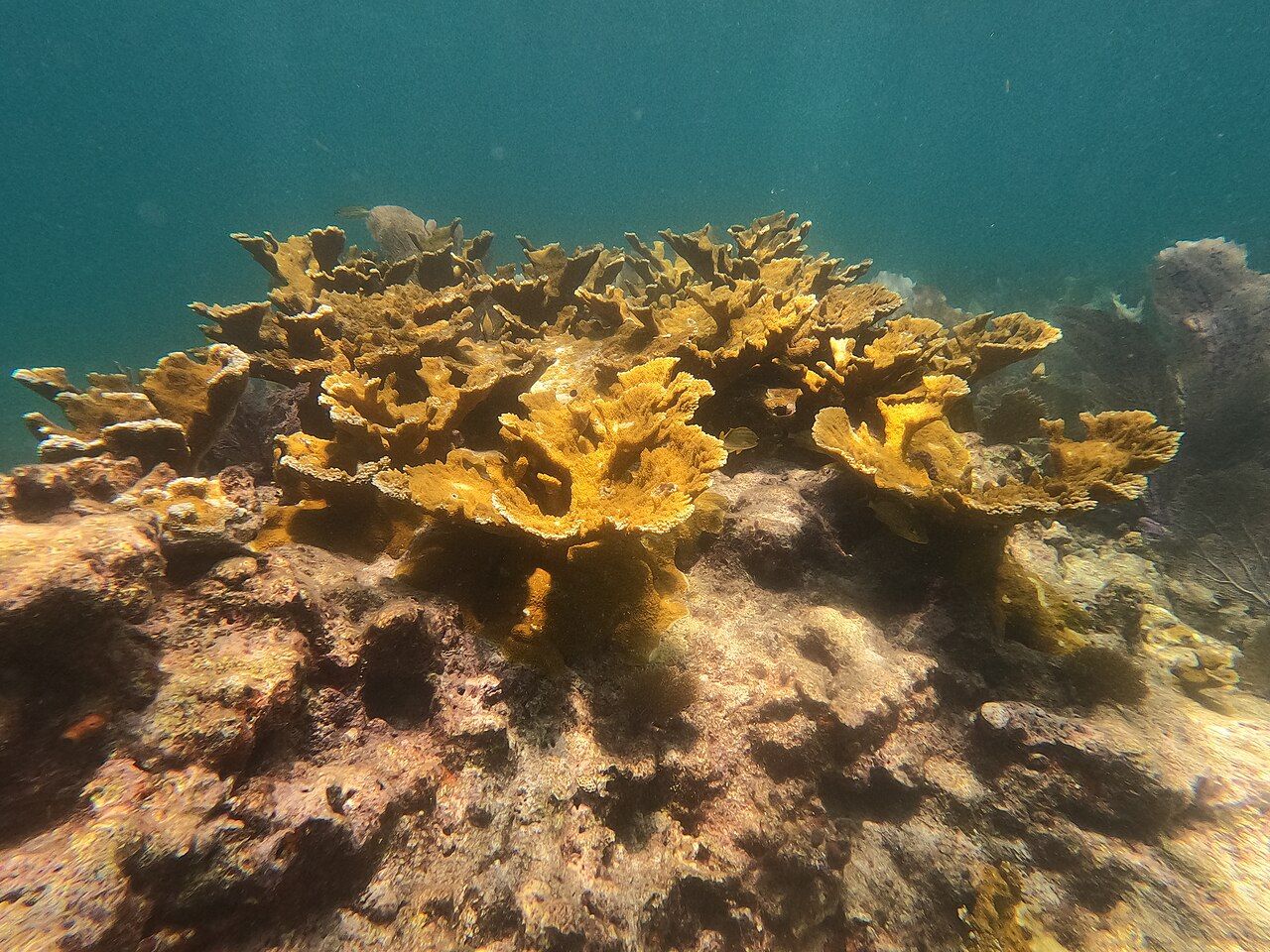
Photo: Elkhorn coral (Acropora palmata), an endangered reef-building species across the Caribbean. Photo: Jstuby, Wikimedia Commons (CC0).
One booking, two stories
Say a family books a US$150 reef tour.
- Today, on a big booking site - US$30-45 taken: The site takes 20-30%: US$30-45. The operator gets US$105-120, then pays for fuel, crew, boats and insurance out of what is left.
- On Bluepass - US$27 taken: Bluepass takes 18%: US$27. The operator keeps US$123, and US$7.50 (5% of the booking) goes straight to reef conservation.
That is one booking. Multiply it by every reef trip booked in the Caribbean and the difference adds up fast.
Why the reef matters
Coral reefs are not decoration. They are the business Caribbean tourism sells.
- Visitor spending tied to reefs - US$7.9B+: The Nature Conservancy's estimate for the Caribbean, including accommodation (2019).
- Visitors linked to reefs - 11M+: TNC estimate for the insular Caribbean.
- Share of all tourism spending - 23%: Reef-linked dollars as a share of Caribbean tourism spending (TNC).
- Barbados - >US$3M: Tourism spending per square kilometre of reef each year, among the highest in the region (TNC).
Where the money goes today
Caribbean tourism leaks money. UN-linked studies put the share that leaves small island economies at 40-50% or more, covering hotels, food, flights and profits. Booking commissions are one part of that leak, and the biggest booking sites are based far away:
- GetYourGuide - Berlin: Headquartered in Berlin, Germany since 2012.
- Viator - Needham, MA: Part of Tripadvisor, based in Needham, Massachusetts.
- Booking.com - Amsterdam: Headquartered in Amsterdam, the Netherlands.
Where a company is headquartered does not prove where every commission dollar ends up. Our comparison treats the incumbent commission as money leaving the local economy, and we state that as an assumption.
What if Bluepass replaced them?
Here is the worked example behind the headline numbers, step by step.
- Our working estimate is that the big booking sites take US$50-70M a year in commissions from Caribbean marine tourism. We have not verified this for GetYourGuide, Viator or the sector as a whole; it is an assumption. We use the middle: US$60M.
- At a 30% commission, US$60M of commissions means about US$200M of bookings.
- Bluepass takes 18% instead of 30% on those same bookings, at the same guest prices. Operators keep 82% instead of 70%: US$164M instead of US$140M. That is US$24M more staying with local businesses every year.
- Bluepass commits 5% of every booking's value to conservation: US$10M a year. That is about five times the whole US$2M WANSEC reef-restoration grant at the University of the West Indies, every year, and it comes from the market rather than a grant cycle.
- A second 5% (another US$10M) goes to marketing, storytelling and partnerships in the region, which build the audience for the next bookings. We count this separately and never add it into the conservation figure.
- Jobs and tax: the money that stays is US$34M a year (US$24M to operators plus US$10M to conservation). If half of it becomes local wages, suppliers and profit, that is US$17M. Caribbean tourism supports roughly one job per US$31,000 of that kind of income, so about 550 job-equivalents, plus about US$4M a year of tax at the regional average rate.
These are estimates, not promises. Job-equivalents use regional averages. Every booking in the niche moving to Bluepass is a best case, not a forecast. And the US$50-70M commission pool is an unverified working assumption. Only real booking data from platforms and operators in the region could settle it.
How we got the numbers
Every dollar figure in this article is modelled from the facts and assumptions below. Facts have sources. Assumptions are ours. The US$50-70M commission pool is an assumption: we have not verified it for GetYourGuide, Viator or the OTA sector, and no total is measured. We state this here and in the footer, and not again.
- Fact: reef tourism - US$7.9B+: Caribbean visitor spending tied to coral reefs, including accommodation (The Nature Conservancy, 2019).
- Fact: OTA commissions - 20-30%: Documented at 20-30% of the booking price. GetYourGuide operators reported about 30% from June 2025 (Arival). Reef earmark in the supplier terms we reviewed: none.
- Assumption: commission pool - US$50-70M: Annual commissions taken from Caribbean marine tourism by OTAs. The headline numbers use the US$60M middle.
- Assumption: incumbent take - 30%: Top of the documented range, applied to every booking.
- Result: bookings - US$167-233M: Pool divided by 30%. At a 20% rate the same pool would imply up to US$350M.
- Bluepass model - 18%: 18% commission: 5 points conservation, 5 points marketing and partnerships, 8 points platform costs and margin. Operators keep 82%, never a guest markup.
- Assumption: local value-added - 25-75%: Share of retained money that becomes new local wages, suppliers and profit. We model 25%, 50% and 75%; the headline uses 50%.
- Fact: jobs ratio - ~US$31k: Caribbean tourism GDP per job: US$85B and 2.75M jobs in 2023 (WTTC, Oxford Economics).
- Fact: tax ratio - 22.8%: Caribbean average tax-to-GDP (OECD, 2021). An average, not a marginal tax rate.
The full range across the US$50-70M pool:
- Operators keep more - +US$20-28M: US$50M pool: +US$20.0M. US$70M pool: +US$28.0M. Against keeping 70% at a 30% commission.
- Conservation at 5% - US$8.3-11.7M: 5/18 of the commission, about 28 cents in every commission dollar.
- Marketing and partnerships - US$8.3-11.7M: The second 5%, counted separately and never added to conservation.
- Jobs at 25% value-added - ~230-320: US$7.1-9.9M of value-added. Tax US$1.6-2.3M.
- Jobs at 50% value-added - ~460-640: US$14.2-19.8M of value-added. Tax US$3.2-4.5M. This is the case the headline uses.
- Jobs at 75% value-added - ~690-960: US$21.3-29.8M of value-added. Tax US$4.9-6.8M.
All jobs figures are job-equivalents, not forecasts. To test the pool itself: if 30-60% of eligible bookings are sold online and 30-40% of those go through OTAs at 30% commission, the pool implies a booking base of US$0.7-2.6B. Using TNC's US$2.2B of reef-activity visitor spending as a proxy base gives US$59-158M of commission, against our US$50-70M assumption. The pool scales with the base, and only booking data could settle it.
Sources
- Headquarters: GetYourGuide careers (Berlin since 2012) and legal notice (GetYourGuide Deutschland GmbH, Berlin); Booking.com careers (Amsterdam headquarters); Booking Holdings 10-K, FY2025 (principal executive offices in Norwalk, Connecticut; Booking.com headquartered in the Netherlands); Tripadvisor investor FAQ (Needham, Massachusetts).
- The Nature Conservancy, Caribbean coral reef tourism study (2019), summary and full study - reef tourism values, GDP and jobs shares.
- Tripadvisor Q4 2024 earnings call - Viator gross bookings ~US$4.2B in 2024; Viator supplier terms and GetYourGuide supplier terms - commission definitions; Arival (June 2025) - GetYourGuide commission increases reported by operators.
- UN Atlas of the Oceans - leakage definitions, UNCTAD import-leakage estimate, 1996 UN Caribbean country figures; ECLAC, Caribbean tourism-agriculture linkages - World Bank 55% estimate and leakage discussion; One Earth (2019), tourism-dependent small islands30276-3) - 55% to 80%+ leakage for some SIDS.
- Arival (April 2025) - OTAs at 33% of all tour and activity operator bookings worldwide in 2024 (a share of all bookings, not of online ones); PhocusWire on Arival and Phocuswright, Travel Experiences 2026 - 33% of experiences booked online worldwide in 2025. Both are global context, not inputs to the calculation.
- UWI Mona, WANSEC research spotlight - the US$2M grant and project scope.
- WTTC / Oxford Economics, Economic Impact Research 2024 (May 2024) - US$85B GDP contribution and 2.75M jobs in 2023, ~3M jobs and 15.7% of employment projected for 2024; WTTC Research Hub, Caribbean report.
- OECD, Revenue Statistics in Latin America and the Caribbean 2023 - Caribbean average tax-to-GDP of 22.8% (2021); OECD 2026 edition - Barbados and Jamaica at 30.7% (2024).
All dollar figures are modelled from the facts and assumptions listed in "How we got the numbers", including the unverified US$50-70M commission pool and the 30% incumbent rate. They are not measured market totals. Job-equivalents and tax apply regional average ratios and are not forecasts. What any platform does with its commission beyond its published terms is its own policy.